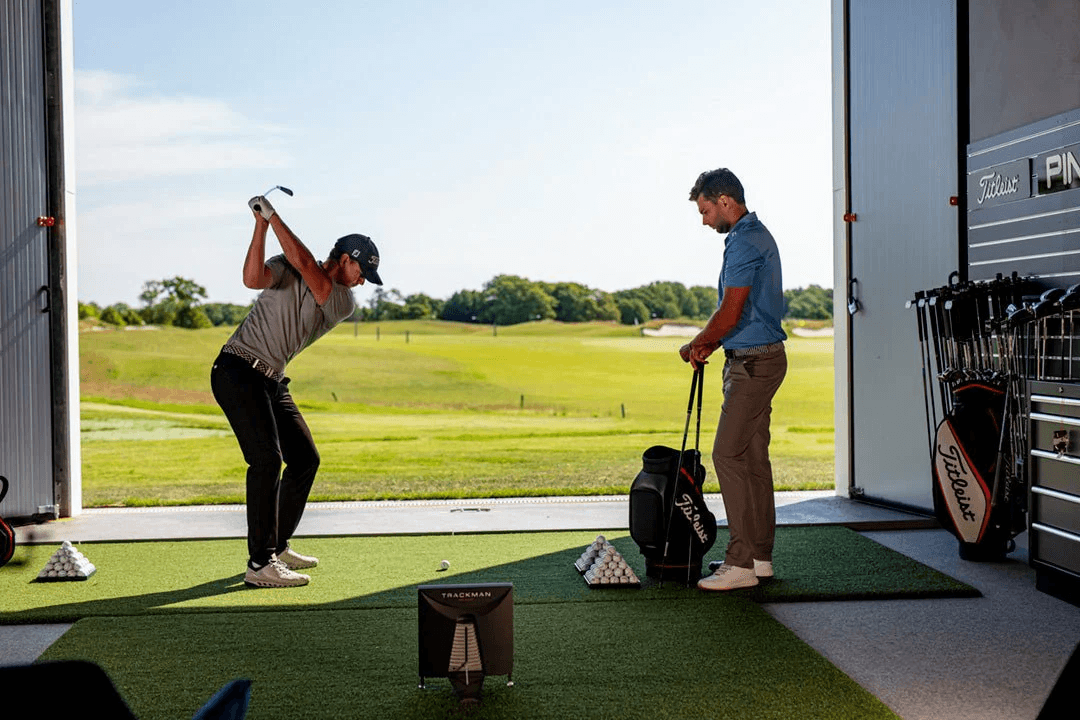
When you watch how the best players in the world practice, you start to notice a pattern. Pros don’t use one launch monitor for everything. They switch tools based on where they’re practicing, the type of work they’re doing, and how much detail they want from each swing.
Outdoors, Trackman 4 is the standard. Indoors, GCQuad runs the show. At home, Tiger uses Full Swing. And in between, GC3 or Bushnell Launch Pro show up when pros need something portable that still delivers numbers they trust.
Once you understand why each system shows up in different environments, the whole picture becomes clear.
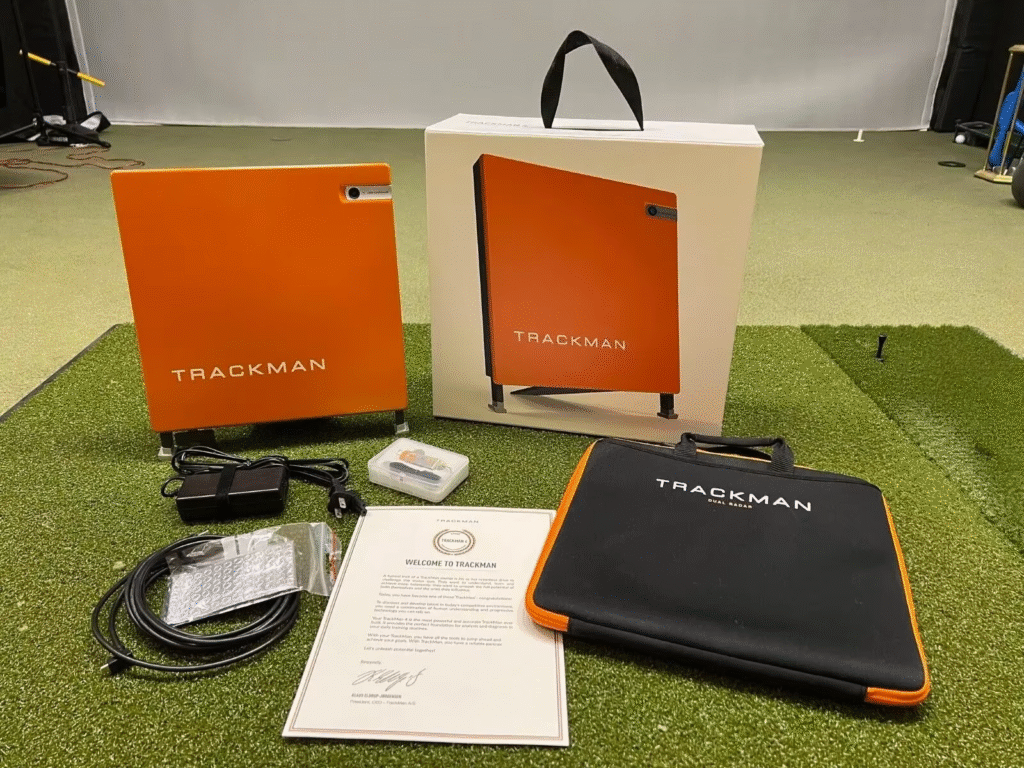
Trackman 4 Is the Go-To Launch Monitor for Pros Outdoors
Step onto a PGA Tour range and Trackman 4 is the unit sitting behind most players. Radar simply makes more sense outdoors because it can track the full flight instead of predicting ball behavior from a short indoor window.
Trackman gives pros a true look at what the ball actually does once it leaves the face. That’s why players use it when they’re working on long irons, shaping shots in the wind, building dispersion patterns, or checking real rollout on firm turf.
Outdoor sessions are all about honest ball flight. That’s Trackman’s strength, and it’s why it continues to dominate practice ranges year after year.
Trackman iO $13,995
GCQuad Takes Over Indoors for One Reason: Precision at Impact
When the practice moves inside, everything changes.
There isn’t enough space for radar to follow the ball, so photometric systems become the only real option. GCQuad rises to the top because it captures impact with a level of detail that helps elite players make micro-adjustments they can trust.
- Spin stays consistent.
- Launch readings don’t drift.
- Face impact location is crystal clear.
- Club data reacts exactly how it should.
This is why GCQuad sits inside fitting bays, tour vans, private studios, and the indoor setups of players who care about precise feedback when they’re grinding on their swing.
GCQuad $15,999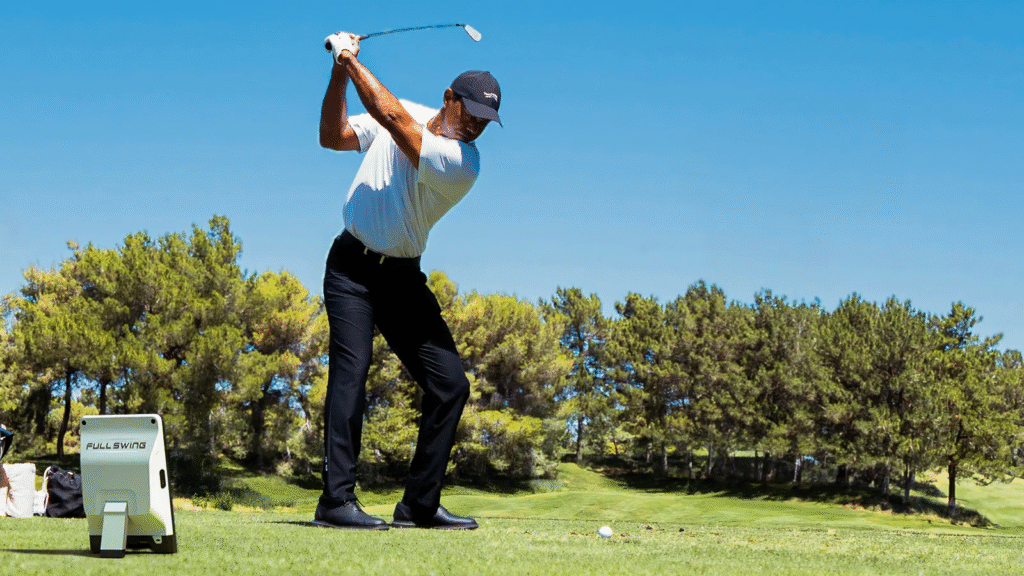
Tiger Woods and Full Swing: Why It Shows Up at His House
Tiger trains at home on a Full Swing simulator, and that setup gets talked about a lot. What people forget is that this is his indoor practice environment, not his outdoor one.
Full Swing works for him because it blends simulation with a smooth indoor experience. The visuals look strong, the feel of the shot is consistent, and it’s built to match the way he practices when he’s off the course.
It doesn’t replace Trackman or GCQuad. It’s simply the tool that fits his home routine.
And when the best player of his generation keeps something in his space, people notice.
Full Swing KIT $4,999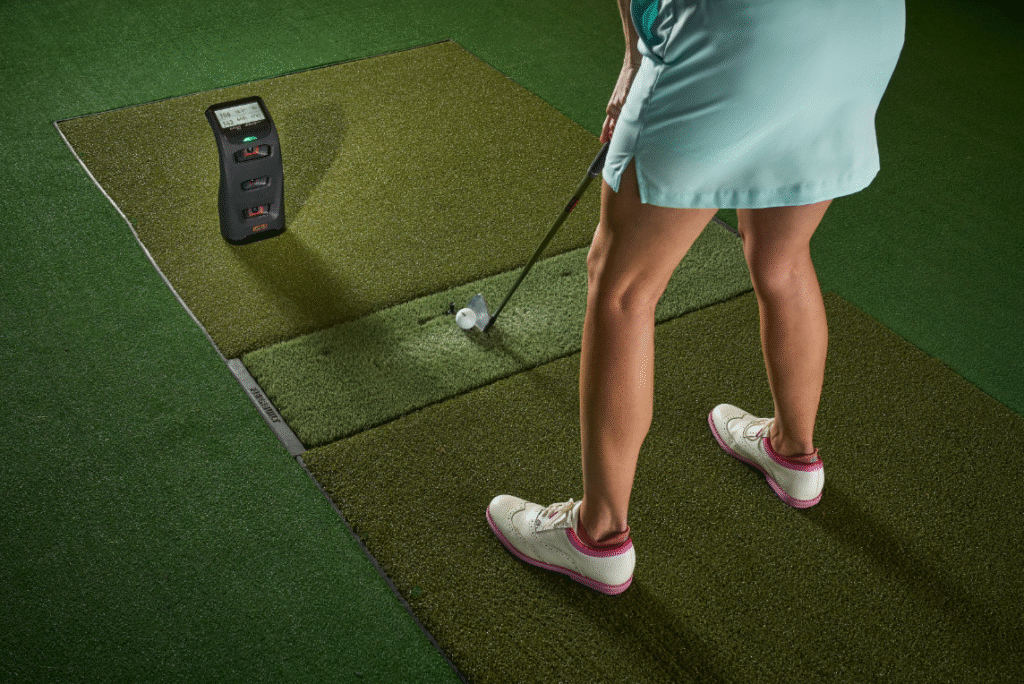
GC3 and Bushnell Launch Pro: Trusted by Pros in Specific Situations
You won’t see GC3 or Bushnell Launch Pro lined up behind players on tour ranges, but they definitely appear in the spaces where convenience and portability matter.
Pros use them when they want:
• reliable ball data during travel
• a quick setup in the garage
• a smaller indoor hitting area
• a secondary device outside of full studio work
• something they can take to events without hauling a full system
These units give tour-level ball data without the footprint or investment of GCQuad. Coaches and fitters also travel with them because they’re easier to move between jobs.
Bushnell Launch Pro $1,999Why Cheaper Launch Monitors Rarely Show Up in Pro Practice
This has nothing to do with price and everything to do with consistency.
Lower-cost systems often struggle with spin variation, wedge accuracy, face-to-path tracking, and tight indoor environments. When a pro is working through a change and needs repeatable numbers, one misread creates doubt.
Pros remove uncertainty. They choose tools they can trust. That usually means GCQuad or Trackman.
Which Launch Monitor Makes the Most Sense for You?
If you’re trying to choose based on your own practice routine, match your environment the same way pros do.
- Indoor practice with a focus on accuracy: GC3 or Bushnell Launch Pro make sense if you want detailed spin numbers without going into GCQuad territory.
- Indoor and outdoor versatility on a tighter budget: SkyTrak+ or FlightScope Mevo+ give a strong mix of accuracy and flexibility.
- Entry-level practice without a big investment: Garmin R10 delivers the basics and helps you understand your swing patterns.
- Building a long-term studio with pro-level expectations: GCQuad or Trackman 4 give you the same foundation players rely on every day.
The goal isn’t to copy what the pros do. It’s to pick the system that fits your goals, your space, and the type of practice that helps you improve.
Foresight GC3 $6,999Final Thoughts
Pros use different launch monitors for different reasons. Trackman 4 rules outdoor ranges because it measures full flight. GCQuad dominates indoors thanks to its precision at impact.
Full Swing fits Tiger’s home setup because it blends realism with convenience. GC3 and Bushnell Launch Pro show up when players want something portable that still produces reliable numbers.
Once you understand how pros match their tools to their environment, it becomes easier to build a setup that actually helps your game. And if you’ve practiced with any of these systems yourself, I’m always curious which one felt the most natural for you.
How Pro Launch Monitor Data Differs from Consumer Data
The raw numbers from a Trackman 4 or GCQuad look similar to what a consumer unit produces - ball speed, spin rate, launch angle, carry distance. But the depth behind those numbers is where the gap widens considerably.
Pro-level monitors capture data at higher frame rates and with tighter tolerances. A GCQuad samples impact at over 10,000 frames per second, which means the spin axis, face angle, and impact location readings reflect what actually happened rather than what a model predicts happened. Consumer monitors often rely on algorithms to fill gaps between fewer data points, which works well for general practice but introduces small variances that compound when you are trying to make half-degree adjustments.
Tour players also get access to proprietary software layers that consumer versions do not include. Trackman’s tour software provides combine scoring, shot distribution heat maps, and real-time benchmarking against PGA Tour averages. These tools allow coaches to identify patterns across hundreds of swings that would be invisible in a single session summary.
Another major difference is calibration frequency. Pro units on tour are calibrated before every session by trained technicians. Consumer units rely on factory calibration and occasional user resets. This is why a pro setup holds tighter accuracy session to session, while a home unit might drift slightly over weeks of use without a manual check.
The club data gap matters too. Pro monitors capture dynamic loft, low point, shaft lean at impact, and 3D club path with a level of precision that directly informs equipment decisions. When a tour player is choosing between two shaft profiles, a difference of 0.3 degrees in dynamic loft or 200 RPM in spin can be the deciding factor. Consumer monitors are less reliable at that resolution.
Should Amateur Golfers Use Pro-Level Monitors?
The honest answer depends on your goals and how you practice. If you hit balls casually a few times a week to stay loose, a pro-level monitor is overkill. The data it provides goes deeper than most recreational golfers need, and the price difference is hard to justify when a SkyTrak+ or Bushnell Launch Pro already gives you the core metrics that drive improvement.
However, there are specific situations where stepping up to a GCQuad or Trackman makes real sense for amateurs. If you are going through a serious club fitting, pro-level accuracy ensures your equipment decisions are based on the tightest possible data. If you are working with a teaching professional who builds lesson plans around launch monitor feedback, having studio-grade numbers removes ambiguity from the coaching process.
Golfers who compete at a high amateur level or who are chasing a specific handicap target also benefit from the deeper analytics. Understanding your spin axis tilt on a 7-iron or your exact dispersion cone with a driver helps you make strategic decisions that shave strokes in ways that feel-based practice simply cannot replicate.
For most home simulator setups, though, the mid-range tier delivers more than enough accuracy. Units in the $2,000 to $7,000 range track ball speed within 1 to 2 MPH of tour-level systems, and the ball flight models are refined enough that your practice sessions translate to the course. The key is matching the monitor to the way you actually use it rather than buying the most expensive option and leaving features untouched.
Frequently Asked Questions
Which launch monitor is most popular on the PGA Tour?
The TrackMan 4 is the most popular launch monitor on the PGA Tour for outdoor ball flight tracking. The Foresight GCQuad is widely used for indoor work and club fitting.
Do I need a pro-level launch monitor to improve?
No. Budget and mid-range launch monitors provide enough data for meaningful improvement. The key metrics for practice - ball speed, launch angle, and carry distance - are accurately captured by monitors in the $500-$3,000 range.
Related Articles
Check out these related guides and reviews from Par Percision: